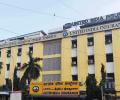
The NITI Aayog has recommended privatisation of state-owned insurer United India Insurance Company as the government aims to move ahead with its new public sector enterprise (PSE) policy for Atmanirbhar Bharat. The policy think tank has suggested that the public sector insurer be considered for privatisation in the banking, insurance and financial services sector, which has been classified as 'strategic' in the PSE policy, said an official. The policy proposes the "bare minimum" presence of government-owned companies in strategic sectors, and privatisation, merger or closure of remaining public sector undertakings (PSUs).

The four public sector general insurance companies -- New India Assurance, United India Insurance, Oriental Insurance, and National Insurance Company -- have lost 800 basis points (bps) in market share in last five years to their private counterparts, the data from the Insurance Regulatory and Development Authority (Irdai) revealed. In 2018-19, the four had a cumulative market share of 40.04 per cent, with New India Assurance having a market share of 14 per cent and United India Insurance with a market share of 9.63 per cent. But, gradually in the past five years, these state-backed firms have lost their market share to private sector players, due to the declining health of their business.

Even as non-life insurers reported muted premium growth in October, standalone health insurers saw a robust 38 per cent year-on-year (Y-o-Y) surge. This growth was driven by pent-up demand in the retail health insurance segment.

The finance ministry has asked state-run general insurers to increase premiums on health insurance, motor and other policies, and refrain from undercutting each other to get new business.


With momentum building around the IPO, the NSE saw a surge in retail investors in the last two years, making it one of the widely traded stocks in the unlisted market.
The Rs 12,450 crore capital infusion will enable the three public sector general insurance companies to improve their financial and solvency position, meet the insurance needs of the economy, absorb changes and enhance the capacity to raise resources and improve risk management.
New India Assurance, National Insurance and United India Insurance are following Oriental Insurance Company in raising health insurance premium rates by 50 to over 100 per cent.

Rates fixed by New India Assurance, Oriental Insurance, United India Insurance and National Insurance after long discussions have been agreed to by the corporate chains
Public and private sector insurance companies are forming alliances to bid for state-run carrier Air-India's aviation cover worth $3.5 billion.

There are four public sector general insurance companies.
The Centre on Friday announced a special voluntary retirement scheme for employees of four public sector general insurance companies to cut the excess flab.

'The plan is to secure nod of the Union Cabinet and other relevant regulatory approvals within the next three months,' a senior finance ministry official said, requesting anonymity.

Multiple reasons accounted for the losses, including manpower crunch and lack of clarity on the merger of National, United and Oriental, reports Namrata Acharya.

Five state-run general insurance companies have a total exposure of Rs 347.64 crore, or 0.14 per cent of their total assets under management (AUM), in Adani group of companies, the finance ministry said on Monday. In a written reply to a question by Congress' Manish Tewari, Minister of State for Finance Bhagwat Karad said Life Insurance Corp (LIC) held Rs 35,917.31 crore in debt and equity of Adani group of companies as on December 31, 2022. This is 0.97 per cent of its total assets under management (AUM) of Rs 41.66 trillion.
In a move that impacts long-term subscribers of medical insurance policies, leading insurers like Oriental Insurance Company and United India Insurance have stopped no-claim bonus for existing and new policy holders.

'The kind of reach it has with so many bank branches even in the remotest part of the country, it is one channel which will play a very important role in vision of insurance for all.'

Employees of public sector general insurance (PSGI) companies are observing nationwide one-day strike on Wednesday to protest against intended privatisation of state-owned insurers. The Joint Front of Trade Unions in PSGI companies met on Monday and decided to protest against the decision of the government to privatise PSGI companies. The unions have given a call for one-day strike against the passage of the General Insurance Business (Nationalisation) Amendment Bill 2021 in the Lok Sabha, General Insurance Employees All India Association general secretary K Govindan said. Employees of all four PSGI companies are participating in the day-long strike, he said.
The three PSU insurers managed a meagre 2-4 per cent growth in business and eroded their market shares, while private players grew by 70 per cent to grab over 14 per cent of the general insurance market during 2003-04.

Kerala, Tamil Nadu and West Bengal have been fiscally stressed for a considerable period of time, and there are no easy ways to mobilise revenues to meet the cost of the promised freebies, particularly in the prevailing difficult economic scenario, points out M Govinda Rao.

Motor insurance is expected to generate largest claims for the companies whereas for crop insurance, the Agriculture Insurance Company is expecting claims of about Rs 15-16 crore
The general insurance industry recorded 12.5 per cent growth in business at Rs 14,452 crore (Rs 144.52 billion) during April-February 2003-04, mainly on the strength of a robust 72 per cent growth of private players.

Presumably hurt on their balance sheets by the allegedly inflated bills for medical costs of people covered by cashless mediclaim facilities, these insurers have pruned the list of hospitals in four large cities for providing this facility with effect from this month.

The Union Cabinet has approved amendments to the General Insurance Business (Nationalisation) Act, paving the way for privatisation of government-owned insurers. The amendments, approved by Cabinet, will remove the clause for the Centre to hold at least 51 per cent in public sector insurance companies at any given time. It will also have an enabling provision for the transfer of management control from the government to the potential buyer of the public sector insurance company. The finance ministry will move amendments to the insurance Act in the ongoing Parliament session.

Public general insurance companies to collaborate for speedy settlement of claims

It will help in reducing the turnaround time.
The change in policy for the three companies, from listing to merger, shows the level of discomfort within the government about their ability to take on the expanded load for insurance coverage with their current financial strength, including the massive premium and claim settlement cover under the proposed universal health coverage plan announced in Budget 2018.

Finance Minister Nirmala Sitharaman on Thursday said the country needs big and world-class banks, and discussions are on with the Reserve Bank and lenders in this regard.

Since no insurance companies share data on their claims with each other, the finance ministry and Irdai suspect that a lot of the resultant claims are duplicates.

The main concern among industry and market experts is that the governance in these companies needs to be strengthened and the focus on social insurance has to come down.

Apart from rail mishaps, the coverage would take care of terrorist attacks and accidental fall of a passenger from a train and normal accidents, riots, robbery and dacoity

'Was the five-day pause ever meant to hold, or was it simply another instrument of signaling, of positioning, of buying time in a war where even the pauses are tactical?' asks Prem Panicker in his must read daily blog on the Gulf War.

The Insurance penetration in India is very low at 3.9 per cent.

Move to strengthen market share and become more profitable.

Alliances fight wars effectively only when they share an endgame. If Israel acted without US knowledge, then the military alliance is operating without real coordination at the level of strategic targeting. Neither picture is reassuring in a war that is no longer regional in its consequences. Prem Panicker continues his must read daily blog on the Gulf War.

Finance Minister Nirmala Sitharaman on Tuesday allayed apprehension that privatisation of state-owned banks would hurt financial inclusion and national interest. She said the bank nationalisation done in 1969 has not yielded the desired result as far as financial inclusion was concerned.

The Bill will come up for discussion in the upcoming winter session of the Parliament.

India's annual oil import bill could rise by $9-11 billion if the country is compelled to move away from Russian crude in response to US threats of additional tariffs or penalties on Indian exports, analysts said. India, the world's third-largest oil consumer and importer, has reaped significant benefits by swiftly substituting market-priced oil with discounted Russian crude following Western sanctions on Moscow after its invasion of Ukraine in February 2022.
